Cryptographic High Value Product (CHVP) is a designation used within the information security community to identify assets that have high value, and which may be used to encrypt / decrypt secure communications, but which do not retain or store any classified information. When disconnected from the secure communication network, the CHVP equipment may be handled with a lower level of controls than required for COMSEC equipment.
Microsoft Forms
Microsoft Forms (formerly Office 365 Forms) is an online survey creator, part of Microsoft 365. == Usage == Forms allows users to create surveys and quizzes with automatic marking. The data can be exported to Microsoft Excel, Power BI dashboards and viewed live using the Present feature. == Phishing and fraud == Due to a wave of phishing attacks utilizing Microsoft 365 in early 2021, Microsoft uses algorithms to automatically detect and block phishing attempts with Microsoft Forms. Also, Microsoft advises Forms users not to submit personal information, such as passwords, in a form or survey. It also place a similar advisory underneath the “Submit” button in every form created with Forms, warning users not to give out their password.
Be My Eyes
Be My Eyes is a Danish mobile app that aims to help blind and visually impaired people to recognize objects and manage everyday situations. An online community of sighted volunteers receive photos or videos from randomly assigned affected individuals and assist via live chat. In 2023, the company launched Be My AI, an AI-based interface to help blind and visually impaired users describe images. The app is currently available for Android, iOS, and Windows. == History == === Founding and early years === The app was developed and marketed by Hans Jørgen Wiberg. He had demonstrated that although there are video chat software such as Skype and FaceTime, none is tailored for the visually impaired. For development, he joined forces with the Danish Association of the Blind, and other organizations. The app was first presented at an event for start-up companies in 2012 and first released in 2015. A version for Android was released in 2017, in addition to the iOS version. Praise was given for easy use of the app. The lack of sufficient data protection, which makes it possible to pass on data to third parties, was criticized. === Recent developments === The company has raised over $650,000, including funding from Silicon Valley, Microsoft, and other angel investors. In February 2020, $2.8 million in Series A funding was raised, allowing the company to further develop its business model while keeping visual support services free for visually impaired users. The investment allows the company to further develop its unique "purpose and profit" business model while keeping the visual support service free and unlimited for all visually impaired users. === User base and accessibility === Over 9.3 million volunteers and 900,000 blind or visually impaired people use the app. == Features == === Human-based assistance === A visually impaired person starts a live stream showing their view from their cellphone camera. They are assigned, through a phone call or chat, a random volunteer who speaks the same language and who is in the same time zone. This allows the volunteer to describe an object and assist the visually impaired person, such as guiding the person to move their camera, read instructions, or clean up a spill. Through speech synthesis, content can be read out loud. This process encourages a more independent life for blind and visually impaired people. === Be My AI === In March of 2023, Be My Eyes launched Be My AI, an AI-based virtual assistant. Be My AI is accessible through the Be My Eyes app, and is based on OpenAI's GPT-4 large language model. Through the interface, the app allows blind and visually impaired users to send images from a variety of devices to be described. The app allows users to then follow up with questions to further tailor the image description. Blind users report using Be My AI for a variety of tasks, including reading menus, identifying clothing, and describing people. The Be My AI interface is available on Android, iOS, and Windows. Within a few weeks of the interface's roll out, the company reported that it had been used one million times, and it was named among Time's best inventions of 2023. Be My AI is part of a growing number of AI-based apps and devices designed to help blind and visually impaired individuals. == Partnerships == === Microsoft === In November 2023, Be My Eyes entered a partnership with Microsoft to share data to help improve accessibility-focused AI models. === Meta === In 2024, Be My Eyes integrated with Ray-Ban Meta smart glasses, a wearable product developed by Meta and EssilorLuxottica. The partnership enabled users to receive hands-free, real-time visual descriptions and volunteer assistance by using voice commands through the smart glasses. === Hilton === In October 2024, Hilton partnered with Be My Eyes to provide live video assistance for blind and low-vision guests. The free service connects travelers to a Hilton team member that can guide them through tasks like adjusting thermostats, opening window shades, or navigating hotel amenities. This collaboration progressed from a prior arrangement where Hilton helped train Be My Eyes' GPT-4 powered AI model to better recognize objects and layouts in hotel rooms. === Tesco === In October 2025, retailer Tesco announced its partnership with Be My Eyes to launch a six-month pilot aimed at improving in-store accessibility in the UK. The initiative was launched on World Sight Day, 9 October, enabling Be My Eyes users to connect directly with Tesco staff via the app for personalised visual assistance while shopping, Euronewsweek reported. == Awards == Nordic Startup Awards for "Best Social Entrepreneurial Tech Startup" in Denmark 2021 Apple Design Award for best social impact
Baby Bundle (app)
Baby Bundle is a parenting mobile app for iPhone and iPad. It was designed to help new parents through pregnancy and the first two years of parenthood. Developed in collaboration with medical experts, it helps track and record the child's development and growth, offers parental advice, manages vaccinations and health check-ups, stores photos and provides baby monitoring services. == History == Baby Bundle was founded in the United Kingdom by brothers, Nick and Anthony von Christierson. Each worked in investment banking prior to developing Baby Bundle, Nick at Greenhill & Co., and Anthony at Goldman Sachs. The idea for the app came when a friend's wife voiced her frustration over having multiple parenting apps on her smartphone. Nick and Anthony left their jobs to create a single app that would include all those features. They conducted market research by interviewing more than 500 parents in the UK and US. It took them a year to build the app, which was named by their mother. Looking for endorsement, they first went to the US in 2013 and partnered with parenting expert and pediatrician Dr. Jennifer Trachtenberg. Baby Bundle was launched in the US and Canadian App Stores in April 2014. In the same month, it became the #1 parenting app in iTunes and was featured by Apple as the #1 Editor's pick across all categories. Mashable called it one of the "Top 5 Can’t Miss Apps." Baby Bundle raised $1.8m seed round in March 2015 to fund development. The money came from a range of angel investors from across the US, UK and Asia. The von Christierson brothers have signed a deal to co-brand the app in the Middle East and expect to launch in Europe and Africa. == Features == Baby Bundle is an app for both the iPhone or iPad and provides smart monitoring tools and trackers for pregnancy and child development. It acts as a growth and daily activity tracker and offers parental advice, manages vaccinations and health check-ups. It has a parenting guide with tips and advice on what to expect when the baby arrives. An interactive forum also lets parents ask questions from others in the community. The app is free and also include paid premium features like the ability to turn two iPhones running into a baby monitor, a cloud service to share the child's data with a spouse and the ability to store data on more than one baby.
Piranesi (software)
Piranesi is an interactive paint system that enables the user to create artistic images from 3D scenes created using conventional modeling applications. == Image format == Piranesi uses the proprietary EPix file format. For every pixel, additional information is stored, such as distance from the viewer and material settings. EPix files can be rendered from 3D scenes using a fixed viewpoint by Piranesi's companion software, Vedute.
Outline of robotics
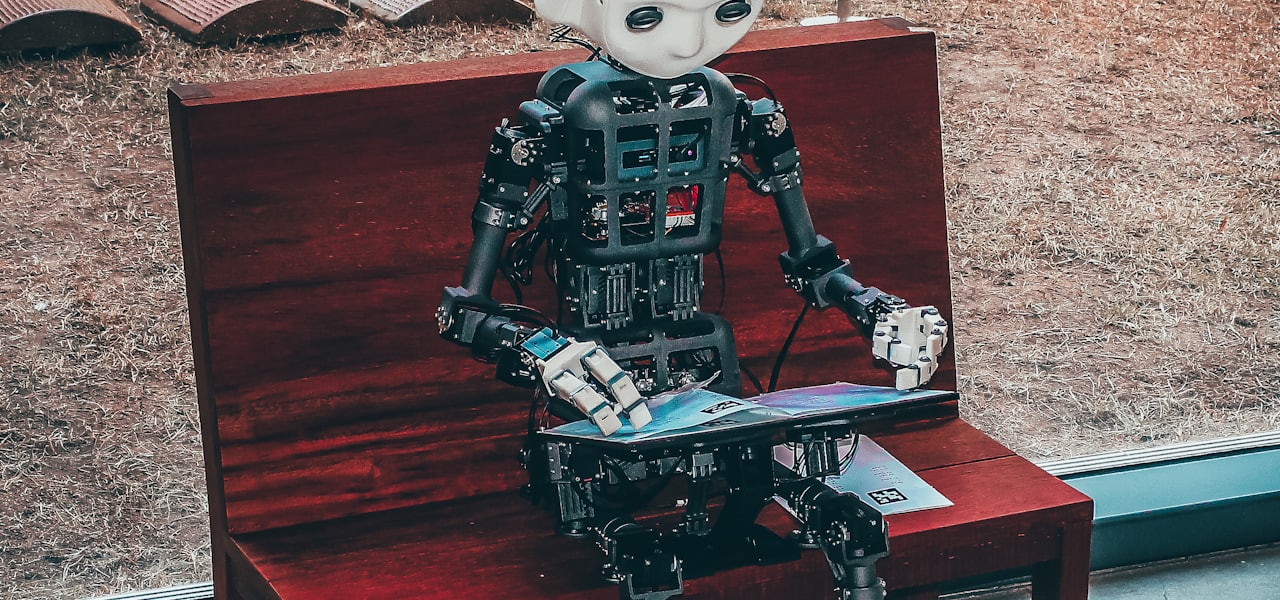
The following outline is provided as an overview of and topical guide to robotics: Robotics is a branch of mechanical engineering, electrical engineering and computer science that deals with the design, construction, operation, and application of robots, as well as computer systems for their control, sensory feedback, and information processing. These technologies deal with automated machines that can take the place of humans in dangerous environments or manufacturing processes, or resemble humans in appearance, behaviour, and or cognition. Many of today's robots are inspired by nature contributing to the field of bio-inspired robotics. The word "robot" was introduced to the public by Czech writer Karel Čapek in his play R.U.R. (Rossum's Universal Robots), published in 1920. The term "robotics" was coined by Isaac Asimov in his 1941 science fiction short-story "Liar!" == Nature of robotics == Robotics can be described as: An applied science – scientific knowledge transferred into a physical environment. A branch of computer science – A branch of electrical engineering – A branch of mechanical engineering – Research and development – A branch of technology – == Branches of robotics == Adaptive control – control method used by a controller which must adapt to a controlled system with parameters which vary, or are initially uncertain. For example, as an aircraft flies, its mass will slowly decrease as a result of fuel consumption; a control law is needed that adapts itself to such changing conditions. Aerial robotics – development of unmanned aerial vehicles (UAVs), commonly known as drones, aircraft without a human pilot aboard. Their flight is controlled either autonomously by onboard computers or by the remote control of a pilot on the ground or in another vehicle. Android science – interdisciplinary framework for studying human interaction and cognition based on the premise that a very humanlike robot (that is, an android) can elicit human-directed social responses in human beings. Anthrobotics – science of developing and studying robots that are either entirely or in some way human-like. Artificial intelligence – the intelligence of machines and the branch of computer science that aims to create it. Artificial neural networks – a mathematical model inspired by biological neural networks. Autonomous car – an autonomous vehicle capable of fulfilling the human transportation capabilities of a traditional car Autonomous research robotics – Bayesian network – BEAM robotics – a style of robotics that primarily uses simple analogue circuits instead of a microprocessor in order to produce an unusually simple design (in comparison to traditional mobile robots) that trades flexibility for robustness and efficiency in performing the task for which it was designed. Behavior-based robotics – the branch of robotics that incorporates modular or behavior based AI (BBAI). Bio-inspired robotics – making robots that are inspired by biological systems. Biomimicry and bio-inspired design are sometimes confused. Biomimicry is copying the nature while bio-inspired design is learning from nature and making a mechanism that is simpler and more effective than the system observed in nature. Biomimetic – see Bionics. Biomorphic robotics – a sub-discipline of robotics focused upon emulating the mechanics, sensor systems, computing structures and methodologies used by animals. Bionics – also known as biomimetics, biognosis, biomimicry, or bionical creativity engineering is the application of biological methods and systems found in nature to the study and design of engineering systems and modern technology. Biorobotics – a study of how to make robots that emulate or simulate living biological organisms mechanically or even chemically. Cloud robotics – is a field of robotics that attempts to invoke cloud technologies such as cloud computing, cloud storage, and other Internet technologies centered around the benefits of converged infrastructure and shared services for robotics. Cognitive robotics – views animal cognition as a starting point for the development of robotic information processing, as opposed to more traditional Artificial Intelligence techniques. Clustering – Computational neuroscience – study of brain function in terms of the information processing properties of the structures that make up the nervous system. Robot control – a study of controlling robots Robotics conventions – Data mining Techniques – Degrees of freedom – in mechanics, the degree of freedom (DOF) of a mechanical system is the number of independent parameters that define its configuration. It is the number of parameters that determine the state of a physical system and is important to the analysis of systems of bodies in mechanical engineering, aeronautical engineering, robotics, and structural engineering. Developmental robotics – a methodology that uses metaphors from neural development and developmental psychology to develop the mind for autonomous robots Digital control – a branch of control theory that uses digital computers to act as system controllers. Digital image processing – the use of computer algorithms to perform image processing on digital images. Dimensionality reduction – the process of reducing the number of random variables under consideration, and can be divided into feature selection and feature extraction. Distributed robotics – Electronic stability control – is a computerized technology that improves the safety of a vehicle's stability by detecting and reducing loss of traction (skidding). Evolutionary computation – Evolutionary robotics – a methodology that uses evolutionary computation to develop controllers for autonomous robots Extended Kalman filter – Flexible Distribution functions – Feedback control and regulation – Human–computer interaction – a study, planning and design of the interaction between people (users) and computers Human robot interaction – a study of interactions between humans and robots Intelligent vehicle technologies – comprise electronic, electromechanical, and electromagnetic devices - usually silicon micromachined components operating in conjunction with computer controlled devices and radio transceivers to provide precision repeatability functions (such as in robotics artificial intelligence systems) emergency warning validation performance reconstruction. Computer vision – Machine vision – Kinematics – study of motion, as applied to robots. This includes both the design of linkages to perform motion, their power, control and stability; also their planning, such as choosing a sequence of movements to achieve a broader task. Laboratory robotics – the act of using robots in biology or chemistry labs Robot learning – learning to perform tasks such as obstacle avoidance, control and various other motion-related tasks Direct manipulation interface – In computer science, direct manipulation is a human–computer interaction style which involves continuous representation of objects of interest and rapid, reversible, and incremental actions and feedback. The intention is to allow a user to directly manipulate objects presented to them, using actions that correspond at least loosely to the physical world. Manifold learning – Microrobotics – a field of miniature robotics, in particular mobile robots with characteristic dimensions less than 1 mm Motion planning – (a.k.a., the "navigation problem", the "piano mover's problem") is a term used in robotics for the process of detailing a task into discrete motions. Motor control – information processing related activities carried out by the central nervous system that organize the musculoskeletal system to create coordinated movements and skilled actions. Nanorobotics – the emerging technology field creating machines or robots whose components are at or close to the scale of a nanometer (10−9 meters). Passive dynamics – refers to the dynamical behavior of actuators, robots, or organisms when not drawing energy from a supply (e.g., batteries, fuel, ATP). Programming by Demonstration – an End-user development technique for teaching a computer or a robot new behaviors by demonstrating the task to transfer directly instead of programming it through machine commands. Quantum robotics – a subfield of robotics that deals with using quantum computers to run robotics algorithms more quickly than digital computers can. Rapid prototyping – automatic construction of physical objects via additive manufacturing from virtual models in computer aided design (CAD) software, transforming them into thin, virtual, horizontal cross-sections and then producing successive layers until the items are complete. As of June 2011, used for making models, prototype parts, and production-quality parts in relatively small numbers. Reinforcement learning – an area of machine learning in computer science, concerned with how an agent ought to take actions in an environment so as to maximize some notion of cumulative reward. Robot
Agent-assisted automation
Agent-assisted automation is a type of call center technology that automates elements of what the call center agent 1) does with his/her desktop tools and/or 2) says to customers during the call using pre-recorded audio. It is a relatively new category of call center technology that shows promise in improving call center productivity and compliance. == Types of agent-assisted automation == === Pre-recorded audio === Pre-recorded audio (sometimes referred to as soundboard (computer program) or as soundboard technology) is another form of agent-assisted automation. The purpose of using pre-recorded messages is to increase the probability (and in some cases error-proof the process so) that the right information is provided to customers at the right time. The required disclosures are pre-recorded to ensure accuracy and understandability. By integrating the recordings with the customer relationship management software, the right combination of disclosures can be played based on the combination of goods and services the customer purchased. The integration with the customer relationship management software also ensures that the order cannot be submitted until the disclosures are played, essentially error-proofing (poka-yoke) the process of ensuring the customer gets all the required consumer protection information. Phone surveys are ideal applications of this technology. Whether surveying market preferences or political views, the pre-recorded audio with an agent listening allows the questions to be asked in the same way every time, uninfluenced by the agents' fatigue levels, accents, or their own views. === Fraud prevention === Fraud prevention is a specialized type of agent-assisted automation focused on reducing ID theft and credit card fraud. ID theft and credit card fraud are huge threats for call centers and their customers and few good solutions exist, but new agent-assisted automation solutions are producing promising results. The technology allows the agents to remain on the phone while the customers use their phone key pads to enter the information. The tones are masked and the information passes directly into the customer relationship management system or payment gateway in the case of credit card transactions. The automation essentially makes it impossible for call center agents and also call center personnel that might be monitoring the calls to steal the credit card number, social security number, or other personally identifiable information. === Outbound telemarketing === Another specialized application space of agent-assisted automation is in outbound telemarketing, which goes under numerous headings including outbound prospecting, cold calling, solicitation, fund-raising, etc. Turnover is high among agents engaged in this kind of work because the task is tedious and emotionally difficult. It is tedious because the agent spends the bulk of their day, not talking to qualified leads, but in getting wrong numbers and answering machines. == Benefits == Just as automation has benefited manufacturing by reducing the mental and physical effort required of workers while simultaneously improving throughput, quality, and safety, agent-assisted automation is improving call center results while reducing the tiring aspects of the job for agents. In some cases, the agent-assisted automation streamlines the process and allows calls to be handled more quickly. By eliminating cutting and pasting from one application to another, by auto-navigating applications, and by providing a single view of the customer, agent-assisted automation can reduce call handle time and increase agent productivity. Second, in theory, the more steps that can be automated and the more logic that can be built into the call flow (e.g., if the customer buys items 2 and 9, then disclosures a, c, and f are read by the pre-recorded audio), then companies may be able to reduce the amount of training that is required of the agents while at the same time ensuring more consistency and accuracy. However, no published studies have reported this result yet. But an even larger problem in call centers is between-agent variation in behavior and results. Agents differ in the amount of training and coaching they receive, they differ in the amount of experience they have, their jobs are repetitious and tiring, and the process and procedures the agents are supposed to follow constantly change. Moreover, there are significant individual differences between agents in their intelligence, personality, motivations, etc. which all affect performance. Despite the large amount of money call centers have spent over decades trying to reduce between-agent variation, the problem is still so prevalent that one large study of customer interactions with call centers found that a customer's experience was completely a function of the quality of the agent who happened to answer the phone. Therefore, the most significant benefit of agent-assisted automation may prove to be in how the automation error-proofs or poka-yoke the process and ensures that something that needs to be done or said happens every time. Properly implemented, the between-agent variation for whatever step of the process the automation is applied to may be able to be reduced to near zero. This is especially important in a collection agency whose processes and procedures are closely regulated by the Fair Debt Collection Practices Act.